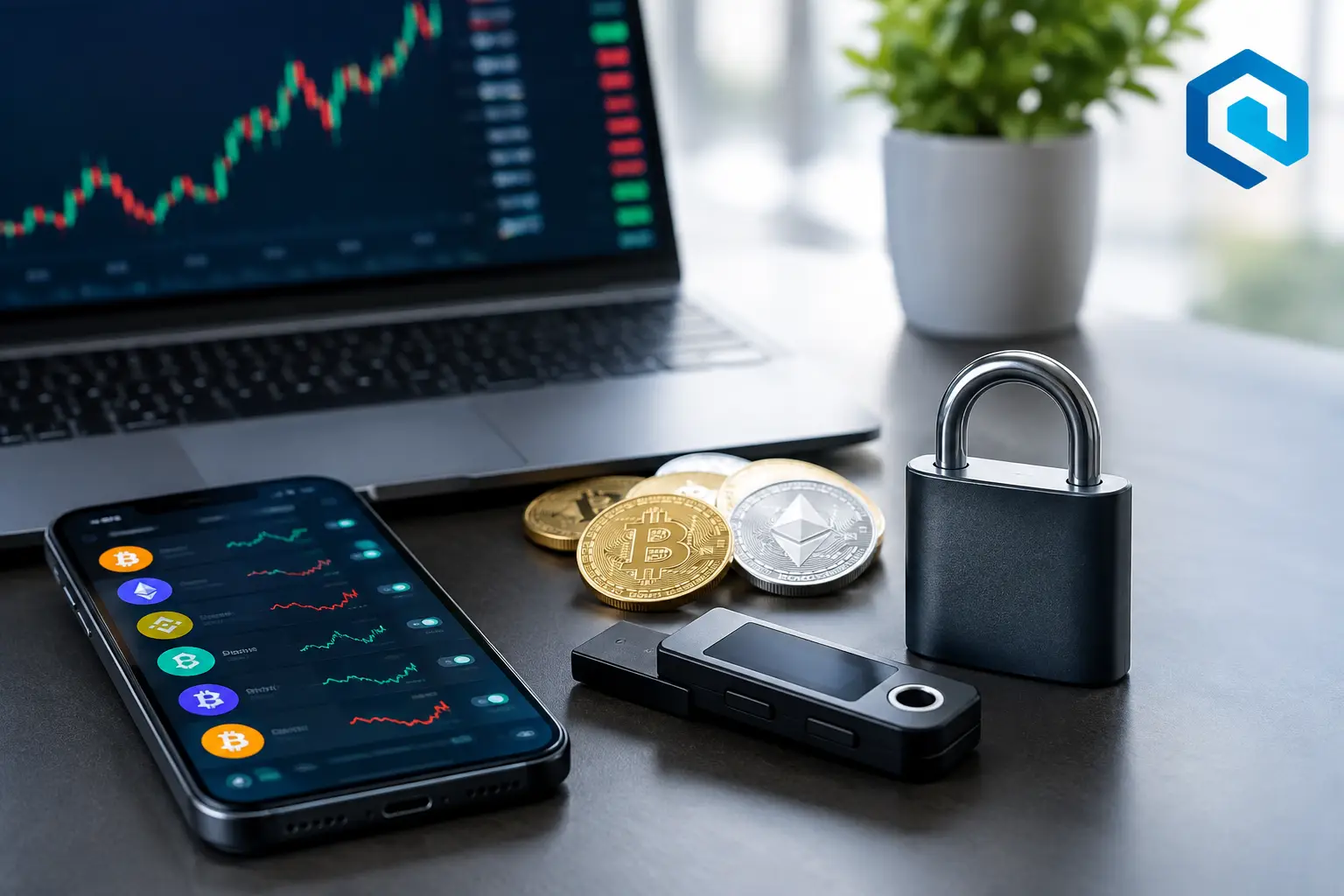
Crypto Security for Multi-Exchange Traders
Building crypto security around strong account access, hardware wallets, restricted API keys, and organized records that keep your assets under control.
A trader can do everything right on a chart and still lose funds through a weak password, a compromised email inbox, or an API key with more permissions than it needs. Crypto security is not one setting or one device. It is the operating system behind how you access exchanges, hold assets, connect tools, and respond when something looks wrong.
For multi-exchange traders, the challenge is operational as much as technical. More platforms, wallets, devices, and tax records create more points of exposure. The goal is not to eliminate every risk. It is to reduce the chance that one compromised account, device, or credential can put your entire portfolio at risk.
Crypto Security Starts With a Map of Access
Start by documenting where access actually lives. Most serious crypto users have more exposure than they realize: exchange logins, a primary email address, two-factor authentication apps, hardware wallets, browser wallets, API connections, cloud storage, and tax documents. If you cannot identify every path to your funds and data, you cannot secure it consistently.
Separate these functions whenever possible. Your primary email account should not be treated as a casual inbox. It is often the reset point for exchange accounts, wallet services, and financial applications. Secure it with a unique password, phishing-resistant two-factor authentication when available, and recovery details that only you control.
Then review every exchange account. Remove old devices and unused API keys. Check withdrawal addresses, login history, notification settings, and recovery options. A security review is not a one-time onboarding task. It should become part of your monthly operating routine, especially after changing phones, traveling, or testing a new trading tool.
Use a Password Manager, Not Memory
Reused passwords turn a breach on an unrelated service into a crypto risk. A password manager lets you create long, unique credentials for every exchange, wallet-related service, and email account without relying on memory or predictable variations.
The trade-off is clear: the password manager becomes an important account to protect. Use a strong master password, enable its strongest available two-factor authentication, and store emergency recovery information offline. Do not save seed phrases, private keys, or exchange backup codes in a plain-text note, screenshot folder, or unencrypted cloud document.
Secure Exchange Accounts Before You Trade
Exchanges are convenient execution venues, but they are also high-value targets. Protecting an exchange account begins with access controls, then extends to withdrawal controls and behavior monitoring.
Enable two-factor authentication using an authenticator app or a hardware security key where supported. SMS-based authentication is better than no second factor, but it is more exposed to SIM-swap and phone-number takeover attacks. If an exchange allows several methods, choose the strongest one you can reliably maintain.
Use withdrawal address allowlists when they fit your workflow. With an allowlist enabled, withdrawals can only be sent to approved addresses, often after a cooling-off period for new destinations. This can add friction when you need to move funds quickly, so it depends on your trading style. For capital you do not need to move frequently, that friction is a useful control.
Pay attention to alerts. Login notifications, withdrawal confirmations, new-device alerts, and API permission changes should reach an inbox you actively monitor. A message about an unfamiliar login is not something to review later after the market calms down. It is a signal to change credentials, revoke sessions, and inspect permissions immediately.
Avoid entering exchange credentials from links in email, text messages, social posts, or direct messages. Sophisticated phishing sites can look nearly identical to legitimate exchange pages. Open exchanges from a verified bookmark or type the address yourself. The few seconds saved by clicking a link are not worth the exposure.
Wallet Security Depends on the Wallet's Job
Self-custody gives you direct control, but it also makes you responsible for key management. A wallet used for long-term holdings should not have the same risk profile as a wallet used to test decentralized applications, mint tokens, or sign frequent transactions.
For meaningful long-term balances, a hardware wallet is usually the stronger default. It keeps private keys off an internet-connected computer and requires you to verify transaction details on the device itself. Buy devices from trusted sources, initialize them yourself, and verify receiving addresses on the hardware wallet screen rather than trusting a browser extension alone.
Your seed phrase is the master key. Anyone who has it can generally recreate the wallet and transfer its assets. Never enter it into a website, send it to support personnel, or store it digitally for convenience. Write it down carefully, confirm every word, and keep it in a secure physical location. Consider a second protected backup only if you can manage the added complexity without expanding exposure.
Use a separate hot wallet for on-chain activity. Keep only the amount needed for active transactions there, and treat every signature request as a financial decision. A transaction can grant token approvals or permissions that remain active after the immediate interaction. Review connected sites and token allowances regularly, particularly if you use newer protocols or experimental applications.
API Keys Are a Crypto Security Control Point
API connections make portfolio tracking, reporting, and automation far more efficient. They can also create avoidable risk when configured carelessly. The correct setup is based on least privilege: grant only the permissions the connected service needs, and nothing more.
A portfolio dashboard typically needs read-only access to balances, order history, trades, and transfers. It should not need permission to place trades, initiate withdrawals, modify account settings, or create new API keys. Before connecting, inspect the permissions one by one. If an exchange offers an IP allowlist for API access, use it when the connected provider supports a stable address range.
Treat an API secret like a password. Do not paste it into chat tools, support tickets, spreadsheets, or public code repositories. Store backup details only where they are protected, and label each key by its purpose. Clear labels make it easier to identify keys that are no longer needed after a trial, a workflow change, or a team transition.
The Crypto Hub is designed around this boundary: users connect exchange accounts through read-only API keys while retaining custody and execution authority on their exchanges. That model improves visibility without requiring a portfolio management platform to hold funds or gain trading permissions. Still, users should verify permissions at the exchange level because that is where each key's authority is defined.
Revoke old keys rather than assuming they are harmless. An inactive connection can remain a useful target if it still exposes transaction history or account balances. During periodic reviews, compare active API keys on every exchange against the tools you currently use. If there is no clear owner and purpose, remove it.
Keep Tax and Portfolio Data Inside Your Security Plan
Crypto security also includes sensitive financial data. Trade history, wallet addresses, cost basis records, and tax reports can reveal more about your holdings and activity than many users expect. Protect this information with the same discipline you apply to exchange access.
Use separate, protected storage for exports and reports. Limit who can access shared folders, especially if you work with an accountant, business partner, or family member. Provide only the records required for the task, and remove access when the engagement ends. In regulated markets such as the United States and Europe, clean records also make it easier to respond to tax and compliance requirements without searching across old exchange emails and spreadsheets.
Centralized visibility helps here because it reduces the number of places where you copy, download, and reconcile sensitive data. The security benefit is not that aggregation removes risk. It is that a controlled workflow can reduce duplicated files, missed accounts, and rushed decisions during tax season.
Build a Response Plan Before You Need One
When an account is compromised, speed matters. Decide in advance which actions you will take: lock or freeze the affected exchange account, revoke API keys and active sessions, change the password from a clean device, secure the associated email account, and review wallet approvals or recent withdrawals. Keep exchange support procedures and recovery details accessible offline, not only inside the account you may lose access to.
Also know when not to act impulsively. If you suspect malware or a device compromise, do not immediately reset every password from that same device. Move to a known-clean device first. If funds have moved, preserve transaction IDs, timestamps, addresses, alerts, and screenshots before details disappear from a session history.
Good security is not about turning every action into a tedious ceremony. It is about putting stronger controls around the actions that can cause irreversible loss. Build those controls into your normal workflow, and managing a complex crypto portfolio becomes more organized, more visible, and far less dependent on luck.