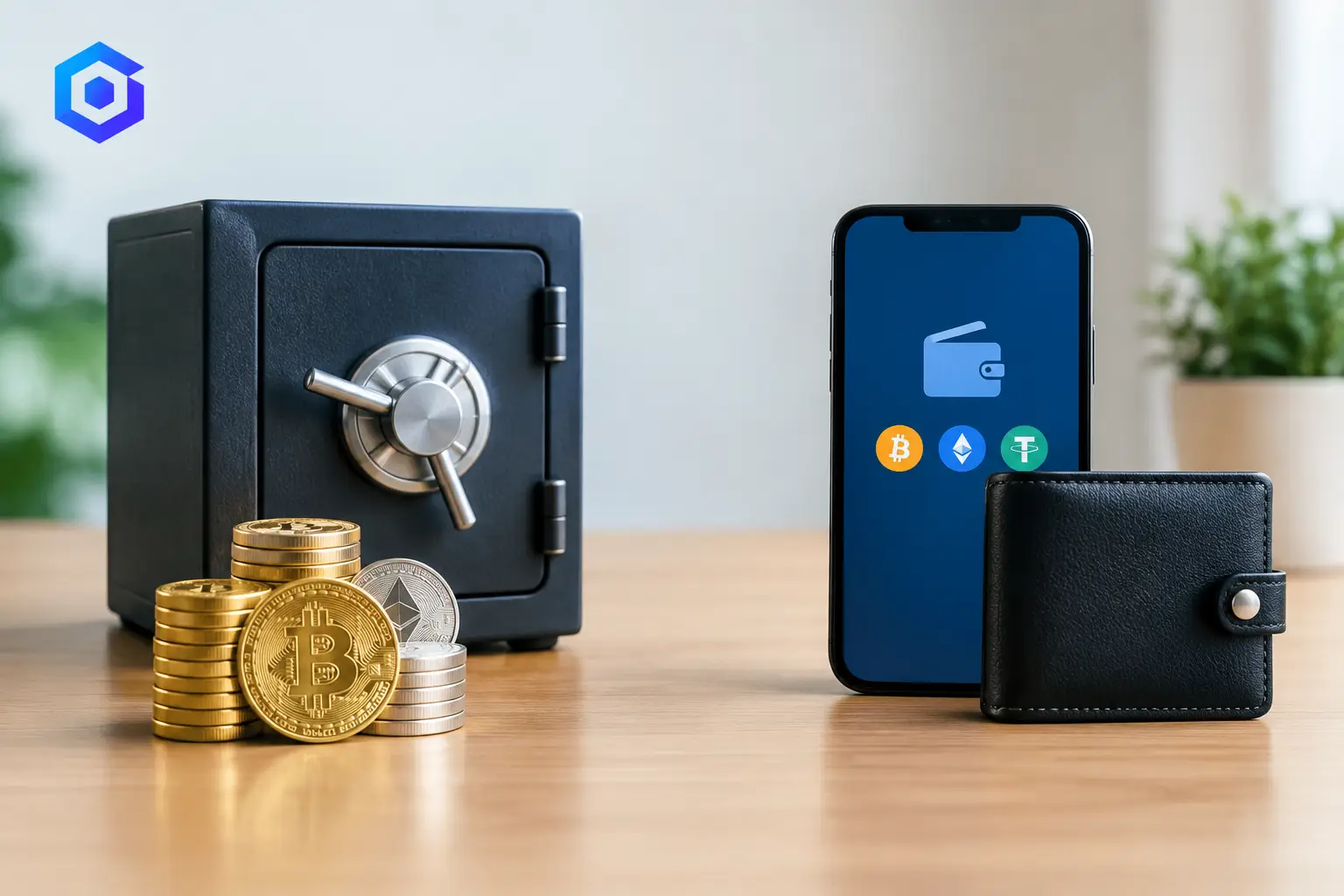
Custodial Versus Noncustodial Platforms
Custodial versus noncustodial platforms determines who controls your crypto. Compare security, access, taxes, and the setup that fits your daily needs.
When an exchange pauses withdrawals, a wallet extension asks for a signature, or a portfolio app requests an API key, the question is the same: who can move your assets? Custodial versus noncustodial platforms is not a minor product distinction. It determines where control sits, how you recover access, which risks you carry, and how you should connect the tools that manage your crypto activity.
For active traders and multi-exchange investors, the practical answer is rarely to choose one model for everything. Most workflows combine custodial exchanges for liquidity and execution with noncustodial wallets for on-chain activity, then use read-only software to organize the full picture. The goal is not ideological purity. It is clear control over every permission in your stack.
What custodial platforms actually control
A custodial platform holds assets or private keys on your behalf. Centralized exchanges are the most familiar example. You log in with an email, password, and two-factor authentication, while the platform controls the wallets that hold customer balances and processes withdrawal requests.
This setup is convenient for trading. A custodial exchange can provide order books, fiat deposits, derivatives access, account recovery procedures, customer support, and compliance infrastructure. If you lose your password, you can usually reset access through the platform's identity process. That is a meaningful advantage for users who do not want sole responsibility for a seed phrase.
The trade-off is direct. Your ability to access or move crypto depends on the platform remaining operational and approving the transaction. Withdrawals can be delayed by security reviews, maintenance, jurisdictional requirements, or account investigations. In an extreme failure, customers may face delayed access while legal and operational issues are resolved.
Custody also creates counterparty risk. Even a well-known provider can experience a security incident, insolvency, system outage, or policy change. Regulatory protections vary by country and asset type, so users should not assume a crypto balance receives the same treatment as cash held in a traditional bank account.
Custodial does not automatically mean unsafe. Large providers invest heavily in security operations, cold storage, monitoring, and fraud controls. It means the platform is a trusted intermediary, and that trust is part of your risk model.
How noncustodial platforms work
A noncustodial platform does not hold your private keys or have independent authority to transfer your funds. With a self-custody wallet, you control the private key or recovery phrase that authorizes transactions. With a decentralized exchange or lending protocol, transactions are generally approved through your wallet and executed by smart contracts rather than an account operator.
The benefit is direct ownership. No support team can reset a seed phrase, block a valid wallet transaction, or release funds for you. You can move assets whenever the network is available and you retain the credentials required to sign.
That control comes with permanent responsibility. Lose the recovery phrase, expose the private key, sign a malicious approval, or send funds to the wrong address, and there may be no recovery path. Smart contract risk is also real. A noncustodial application can preserve your control over keys while still exposing you to bugs, exploits, fake interfaces, or unsafe token approvals.
Noncustodial should therefore never be treated as shorthand for risk-free. It shifts risk from an intermediary to the user, the wallet security model, and the on-chain protocols being used.
Custodial versus noncustodial platforms: the practical differences
The clearest difference is transaction authority. On a custodial exchange, the provider ultimately processes the withdrawal. On a self-custody wallet, the holder signs the transaction. But operational differences extend beyond withdrawals.
Account recovery is the next major divide. Custodial accounts can often be restored through identity verification. Noncustodial wallets cannot be recovered by a provider if the seed phrase is gone. For some users, that is unacceptable risk. For others, it is the point of self-custody.
Security workflows differ as well. Custodial users need strong unique passwords, phishing-resistant two-factor authentication, withdrawal allowlists, and careful device security. Self-custody users need all of that plus secure seed phrase backup, hardware wallet practices, transaction verification, and disciplined approval management.
Privacy and compliance can differ by platform and jurisdiction. Custodial providers commonly collect identity information and monitor account activity under applicable rules. Noncustodial wallets generally do not require an account to hold assets, although the services connected to them may impose checks. Neither model removes the need to maintain accurate records or meet applicable tax obligations.
Finally, access to markets can shape the decision. Centralized platforms may offer deeper liquidity, advanced order types, fiat rails, and certain derivatives products. Noncustodial protocols may provide direct on-chain access to tokens and decentralized finance applications. The best fit depends on what you are trying to do, not on a label alone.
A third category: noncustodial, read-only management
Crypto operations become confusing when every connected app is assumed to be either an exchange or a wallet. Portfolio management software can be neither.
A noncustodial, read-only platform connects to exchanges and wallets to display balances, transaction history, allocation data, and performance. It does not take custody of funds. It also should not receive trading or withdrawal authority when its purpose is reporting and oversight.
That distinction matters when you connect exchange APIs. API keys can carry different permissions. A read-only key can retrieve balances, orders, and transaction history. A trading-enabled key can place orders. A withdrawal-enabled key can move funds and should almost never be used for portfolio tracking or tax reporting.
For a monitoring workflow, use API credentials restricted to read-only access, disable withdrawals, and review connected keys periodically. This gives you centralized visibility without handing a dashboard control over your assets.
The Crypto Hub is designed around this model: it consolidates holdings, historical performance, allocation monitoring, and tax-ready transaction reporting while users retain custody on their connected exchanges and wallets. That separation is valuable for anyone who wants one operational view without adding another platform that can execute trades or withdraw funds.
Choosing the right setup for your workflow
Most serious users need a layered setup rather than a single platform. Keep active trading capital where it can be deployed efficiently, store long-term self-custody positions with a security process you can maintain, and use read-only aggregation for oversight.
Start with your actual operating needs. If you trade frequently, a reputable custodial exchange may be necessary for execution, liquidity, and order management. If you hold assets long term and understand key management, self-custody can reduce reliance on an intermediary. If you use both, your management system must reconcile activity across both environments.
A useful allocation decision considers four questions:
- How much of this balance needs immediate trading access?
- Can I securely manage recovery materials and hardware wallets?
- What happens if this provider is unavailable for several days?
- Do I have complete transaction records for performance analysis and taxes?
The last question is often overlooked. Custodial exchanges may provide downloadable histories, but records can be fragmented across multiple accounts, product types, and years. Noncustodial activity creates another layer of complexity because swaps, bridges, staking rewards, and transfers may occur across several wallets and networks. A wallet transfer is not necessarily a taxable event, but poor labeling can make it look like one when records are incomplete.
Centralized reporting helps identify duplicate transfers, track cost basis methods such as FIFO, LIFO, or HIFO where available, and produce a clearer audit trail. It does not replace professional tax advice, but it reduces the manual reconciliation that causes costly errors.
Security rules that apply to both models
The strongest setup is built on least privilege. Give each platform only the access it needs to perform its specific job. An exchange needs the permissions required to trade and withdraw under your own controls. A portfolio tracker needs read-only data. A wallet connection should be reviewed before every signature.
Use unique passwords and strong two-factor authentication for custodial accounts. Prefer a hardware security key or authenticator app over SMS where supported. On self-custody wallets, store recovery materials offline, never enter a seed phrase into a website, and verify destination addresses on the hardware wallet screen when possible.
Be equally careful with browser extensions and approvals. A legitimate-looking site can request permission to spend tokens long after a single interaction. Review approvals periodically and revoke permissions you no longer need. Operational security is not one setting. It is a series of small controls that prevent a single mistake from becoming a full account loss.
The right custody model is the one you can operate confidently and document completely. Keep execution, storage, reporting, and tax records aligned, then revisit permissions whenever your trading workflow changes.