Self Custody Portfolio Monitoring That Works
Self custody portfolio monitoring brings exchange, wallet, and tax data into view without giving up control of your keys or trading authority at any point.
6 min readby The Crypto Hub
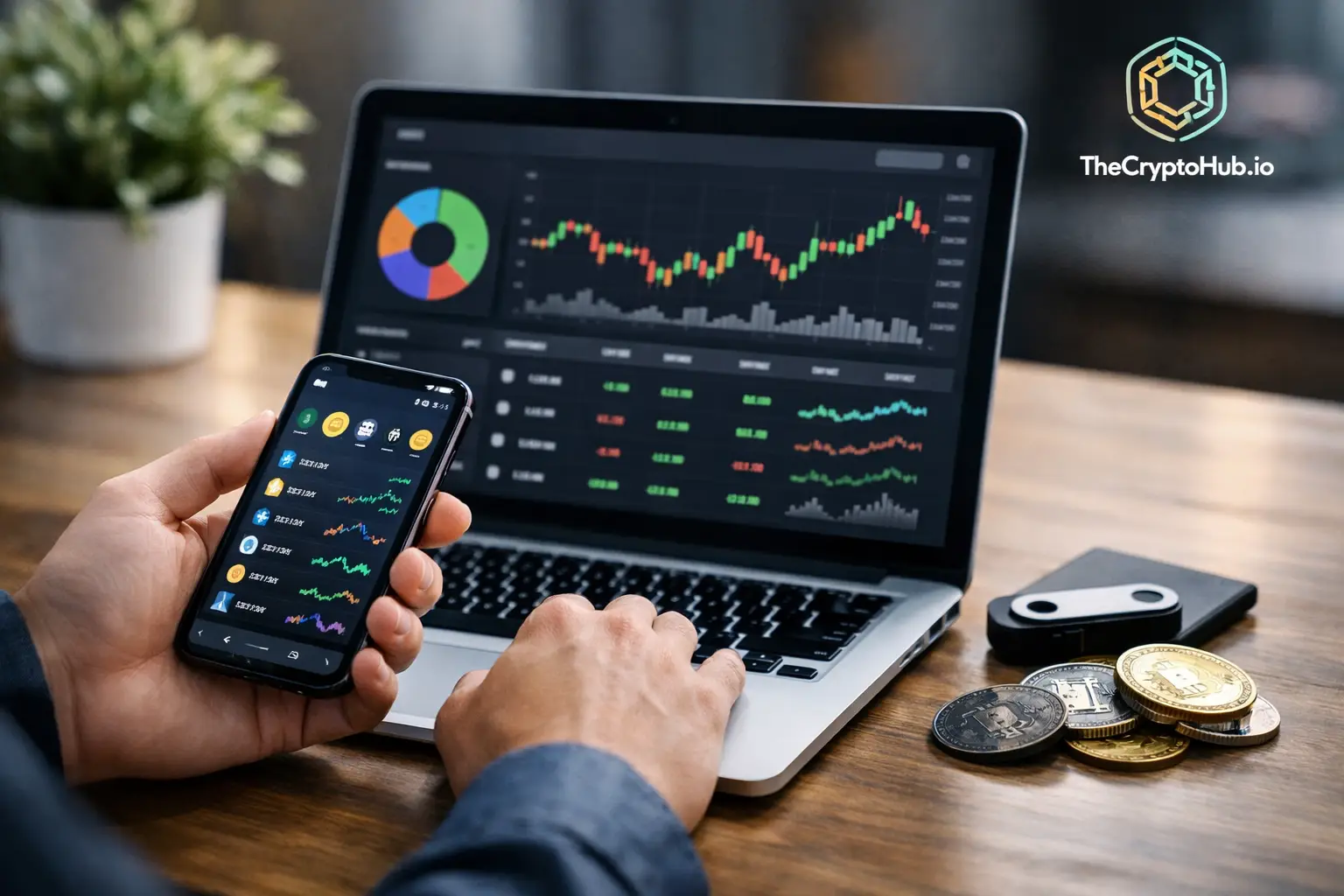
A cold wallet balance tells you what sits at one address. An exchange dashboard shows what is held on one venue. Neither gives you a reliable picture when positions, stablecoins, staking rewards, and derivatives are spread across multiple accounts. Self custody portfolio monitoring is the operating layer that brings those moving parts into one view while keeping control of assets where it belongs: with you.
For active crypto users, this is not simply a convenience feature. It is the difference between making allocation decisions from current data and reacting to a partial snapshot. The objective is straightforward: see the full portfolio, understand how it changed, and preserve strict boundaries around custody and trading authority.
What self custody portfolio monitoring actually means
Self-custody means you control the private keys or the withdrawal authority for assets held in your own wallets. In a broader portfolio workflow, it also means avoiding unnecessary transfer of control to a tracking provider. A monitoring platform should observe balances and activity, not hold funds, sign transactions, or place trades on your behalf.
That distinction matters because “non-custodial” can describe several different setups. Wallet tracking may use public addresses, which exposes balances and transaction history without exposing private keys. Exchange tracking commonly uses API connections, where permissions determine what the platform can do. For monitoring, read-only access is the standard to look for. It can retrieve balances, transactions, and order history while preventing withdrawals and trade execution.
This approach does not eliminate risk. Any connected service remains part of your security perimeter, and wallet addresses can reveal meaningful financial activity. But it sharply limits the damage that a compromised dashboard credential or API connection could cause. Your monitoring system should be a command center, not another custodian.
Why a single exchange balance is not a portfolio
Fragmentation is normal for serious crypto participants. You may keep long-term assets in hardware wallets, maintain trading capital across several exchanges, use stablecoins on-chain, and hold open futures positions separately from spot holdings. Looking at each account in isolation creates blind spots.
Those blind spots show up at the worst times. A trader may believe they have reduced exposure after selling on one exchange, while a wallet allocation has appreciated enough to keep concentration unchanged. An investor may see a portfolio gain without recognizing that it came mostly from one volatile asset. During tax season, missing transfers between wallets and venues can make ordinary internal movements appear as taxable disposals.
A useful portfolio view normalizes this data into comparable values and categories. It should show current total value, individual holdings, allocation percentages, realized and unrealized performance, and account-level balances. For traders, it should also separate spot assets from derivatives exposure where possible. A large stablecoin balance is not the same thing as a low-risk portfolio if leveraged positions are open elsewhere.
Build the monitoring setup around permission boundaries
The fastest setup is not always the safest one. Start by deciding what data needs to be visible, then connect each account using the lowest level of access required.
For self-custodied wallets, monitoring generally requires only public wallet addresses. Never enter a seed phrase or private key into a portfolio tracker. A legitimate tracking workflow has no reason to ask for either.
For centralized exchanges, create dedicated API keys for reporting. Disable withdrawals, disable trading if the exchange allows separate permission controls, and avoid reusing an existing key that has broader privileges. Label each key by platform and date so you can revoke it quickly if needed. If an exchange account supports IP restrictions, use them only when they fit your operational setup and do not prevent reliable syncing.
A disciplined setup usually includes four controls:
- Read-only API permissions for every exchange connection
- Public-address tracking for self-custodied wallets
- Unique passwords and multi-factor authentication for both exchanges and the monitoring platform
- A periodic review of connected accounts, API keys, and inactive wallets
The goal is not to create friction for its own sake. It is to make sure an aggregation tool can provide visibility without gaining the ability to move capital.
Monitor allocation, not just account value
A total portfolio number is useful, but it is a lagging indicator of what you actually own. Allocation monitoring turns that number into an exposure map.
Start with categories that reflect how you make decisions. Many users separate core holdings, stablecoins, trading inventory, on-chain positions, and speculative assets. The exact framework depends on your strategy. A long-term holder may care most about concentration by asset, while an active trader may prioritize venue exposure, stablecoin liquidity, and the notional value tied to open derivatives positions.
Set thresholds before market volatility forces the issue. For example, if one asset rises from 35% to 55% of the portfolio, decide whether that is an intended conviction position or an unplanned concentration risk. If capital on a single exchange exceeds your comfort level, move the discussion from “portfolio performance” to counterparty exposure.
Price alerts are useful when they are tied to decisions. An alert for a price level can prompt a planned rebalance, risk review, or order check. Ten alerts for every small move usually create noise. The same standard applies to portfolio alerts: focus on material changes in total value, allocation, or a position that requires attention.
Make historical performance usable
Crypto performance is easy to misread because deposits, withdrawals, transfers, and rewards can distort simple gain-and-loss charts. If you add cash after a market decline, the account value may recover even when the original positions have underperformed. If you move assets from an exchange to a wallet, the exchange account appears to lose value although your overall ownership has not changed.
Good monitoring separates cash flows from investment performance. It maintains transaction history, identifies transfers between your own accounts, and gives you a way to review cost basis and realized gains. Accuracy improves when you connect accounts early and keep the data feed current rather than attempting to reconstruct a year of activity from exports later.
There are trade-offs. Public wallet data is transparent, but labeling transactions can require context. Exchange APIs are efficient, but available transaction details vary by venue. Complex activity such as bridging, liquidity positions, wrapped assets, airdrops, and derivatives may need review before reports are final. Automation reduces manual work; it does not remove the need to sanity-check unusual transactions.
Treat tax records as part of the monitoring workflow
Tax reporting should not begin after the last trade of the year. It should begin with the same complete transaction data used to monitor the portfolio.
For US taxpayers, cost-basis treatment and taxable-event classification can materially affect reporting. Methods such as FIFO, LIFO, and HIFO may produce different results where permitted and appropriately applied. The operational requirement is consistent, complete records: timestamps, quantities, prices, fees, transfers, rewards, and transaction types.
This is where a connected dashboard can remove a major source of friction. Rather than reconciling exchange exports, wallet activity, and spreadsheets as separate projects, you can review the same underlying activity that informs allocation and performance. The Crypto Hub is designed for that workflow, combining read-only multi-exchange visibility, tracking tools, and tax reporting in one non-custodial environment.
Before filing, review exceptions rather than assuming every imported entry is correct. Look for unmatched transfers, duplicate transactions, assets with missing cost basis, and transactions categorized as income or disposals that do not match your records. A clean portfolio dashboard makes these issues easier to spot months before they become a deadline problem.
A weekly operating routine that stays manageable
Portfolio monitoring fails when it becomes either obsessive or neglected. A short, repeatable weekly review is usually more valuable than constant dashboard checking.
First, confirm that connected exchanges and wallets are syncing and that no account has dropped out of the total. Next, review allocation changes, open exposure, and major asset moves against the plan you already set. Then inspect alerts and transaction exceptions, especially transfers that may need labeling. Finally, check API-key status and remove any connection you no longer use.
Monthly, take a wider view. Compare performance over a meaningful period, review concentration and venue risk, and verify that transaction history is complete for tax purposes. This cadence gives you control without turning routine market movement into a reason to change strategy.
The right monitoring setup should make ownership clearer, not more complicated. Keep custody separate from visibility, connect accounts with the least privilege possible, and use the complete picture to make the next decision with fewer assumptions.
Share this article