Top Tools for Crypto Traders That Save Time
See the top tools for crypto traders, including portfolio tracking, price alerts, charts, security controls, tax reports, and market education today.
6 min readby The Crypto Hub
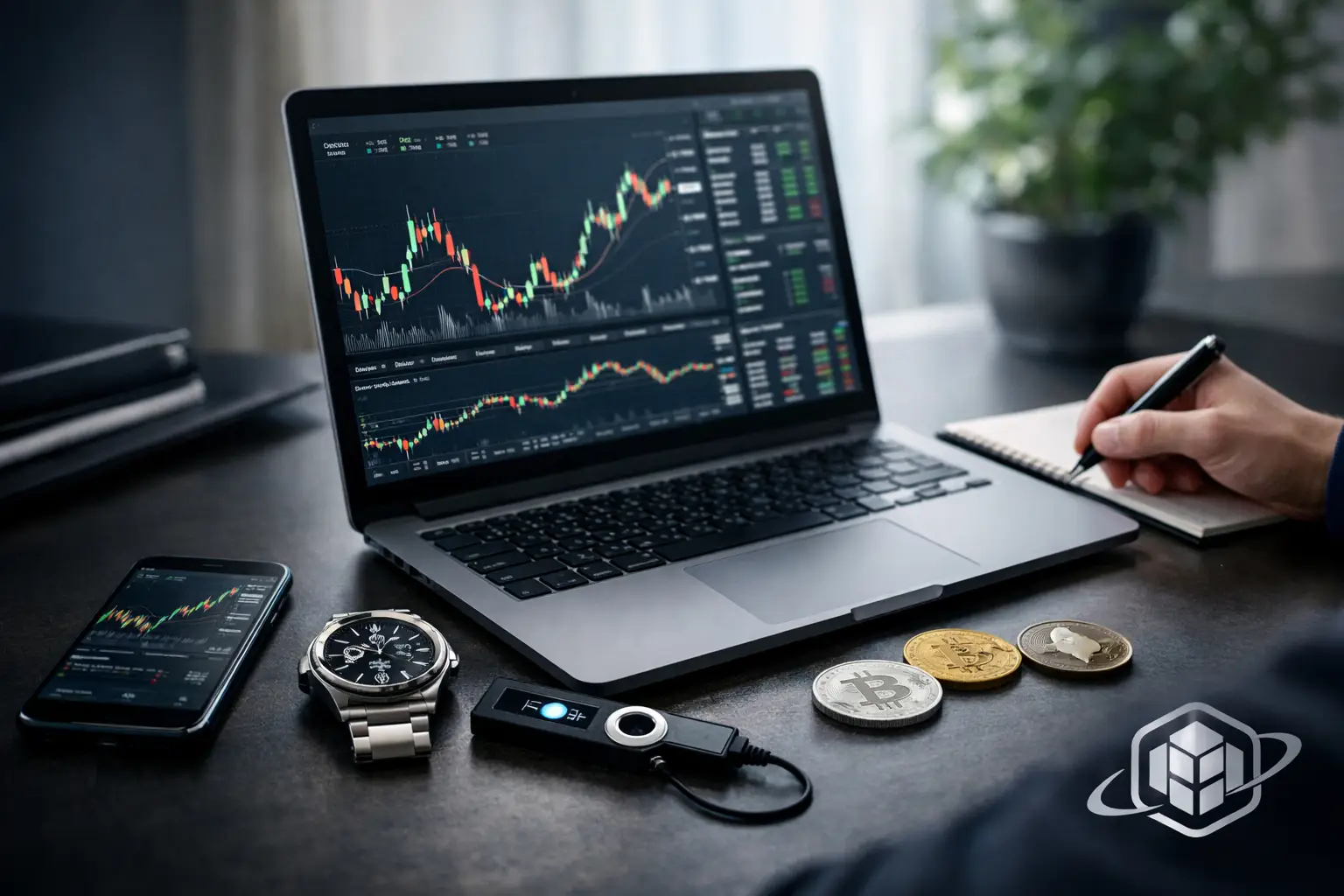
A trader with accounts on several exchanges can place a position in minutes, then lose an hour reconstructing what happened afterward. Balances sit in separate dashboards, cost basis lives in a spreadsheet, alerts arrive too late, and tax records become a year-end project. The top tools for crypto traders solve that operational problem: they turn scattered activity into information that is usable before, during, and after a trade.
The right stack is not necessarily the stack with the most indicators or the loudest social feed. It is the set of tools that gives you a reliable view of exposure, helps you act on a defined process, and creates records you can defend. For active traders, that usually means prioritizing portfolio visibility, market analysis, risk controls, security, education, and tax reporting.
Top Tools for Crypto Traders: Start With Visibility
A portfolio tracker is the command center of a multi-exchange workflow. Without one, it is easy to overestimate available capital, miss a concentration problem, or forget that a supposedly closed trade still has a residual position on another venue.
Look for a tracker that aggregates spot holdings, derivatives exposure, and transaction history across the exchanges and wallets you actually use. The useful output is not just a combined account value. It is a current allocation view, realized and unrealized performance, historical balances, asset-level exposure, and a clear record of transfers between platforms.
API connection design matters here. Read-only API keys allow a platform to retrieve balances and transactions without permission to place trades or withdraw funds. That separation is valuable for traders who want centralized oversight while retaining custody and execution control at their exchanges. Before connecting any account, confirm the permissions, use a unique API key, disable withdrawal access, and enable two-factor authentication on the exchange itself.
The Crypto Hub is designed around this command-center approach, bringing multi-exchange portfolio tracking, market tools, education, and tax reporting into one read-only environment. For a trader managing fragmented accounts, consolidating these functions reduces the need to reconcile the same activity across multiple apps.
Charting Tools Should Support a Process
Charting software is useful when it helps you answer a specific question: Is the market trending, ranging, breaking a defined level, or invalidating the setup? It becomes counterproductive when every trade begins with a new collection of indicators.
Build a charting workspace around the time frames and instruments you trade. A short-term trader may use higher-time-frame levels to establish context and lower-time-frame charts for execution. A swing trader may care more about daily and weekly structure, volume behavior, and broader sector rotation. Neither workflow is inherently better. The right one is the one that matches your holding period and risk plan.
A practical charting setup should include clean price data, drawing tools, customizable watchlists, saved layouts, and alerts tied to price levels or technical conditions. If you trade across several pairs, saved templates are more valuable than endlessly customized charts. They create consistency when the market is moving quickly.
Be cautious with indicator overload. More inputs can create the appearance of certainty without improving the decision. Many traders get more value from price structure, volume, a small number of repeatable indicators, and written entry and exit rules than from a crowded screen.
Alerts Turn Monitoring Into a System
Price alerts are among the highest-leverage tools available to active traders because they reduce the need to watch charts continuously. Set them around decision points: a breakout level, a loss of support, a target zone, a liquidation-risk threshold, or a price that changes your thesis.
The best alerts are specific and actionable. “Bitcoin moved 2%” may create noise. “BTC reached the level where I will reassess my short exposure” creates a clear next step. Use alerts to prompt review, not to automate emotion-driven entries.
Risk Tools Protect the Account, Not the Prediction
Crypto markets trade around the clock, and volatility can change quickly. A risk toolset should make your downside visible before you submit an order. That includes position sizing calculators, stop-loss planning, risk-to-reward estimates, and exposure monitoring across correlated assets.
Correlation is often missed in crypto portfolios. Holding several large-cap altcoins may look diversified by ticker, but those positions can respond similarly during broad market moves. A consolidated allocation tool helps reveal whether you are genuinely diversified or simply carrying multiple versions of the same directional bet.
For derivatives traders, monitor leverage, collateral, liquidation levels, and open interest exposure in the same place you review spot holdings. Leverage does not only increase potential returns. It compresses the room available for normal volatility. If a position requires constant attention because liquidation is too close, the sizing may be the real problem.
Risk management is also where automation deserves restraint. Conditional orders and pre-set exits can enforce discipline, but they should be reviewed for thin liquidity, exchange-specific order behavior, and rapid price gaps. No tool removes market risk or guarantees execution at an intended price.
Security Tools Are Trading Tools
Security is often treated as an administrative task until an account compromise interrupts trading. For serious digital asset holders, it belongs in the operating stack.
Use a password manager to generate and store unique credentials, hardware-based or authenticator-app two-factor authentication where supported, and withdrawal address allowlists on exchanges. Review API keys regularly, remove connections you no longer use, and separate read-only monitoring keys from any key with trading permissions.
Device and communication hygiene matter too. Keep operating systems updated, verify domains before signing in, and treat unsolicited direct messages, token offers, and “support” requests as hostile until proven otherwise. A security tool is effective only when the process around it is consistent.
Tax Reporting Tools Need Complete Data
Tax reporting should not begin after the final trade of the year. Every sale, swap, reward, fee, transfer, and derivatives transaction can affect the records needed to calculate gains and losses. Missing transaction history creates a chain of manual reconciliation that is slow and prone to error.
A crypto tax tool should import complete exchange and wallet activity, identify transfers where possible, flag missing cost basis, and support the accounting method appropriate to your circumstances, such as FIFO, LIFO, or HIFO. US taxpayers should also consider whether the tool produces reports that align with their filing workflow and the requirements of their tax professional.
The key trade-off is automation versus review. Automated categorization saves substantial time, but unusual transactions, migrations, staking activity, and on-chain interactions may need manual verification. Treat the report as a controlled output, not a document to file without checking.
Education Tools Help Traders Filter Noise
Crypto moves quickly, and the information environment is crowded with opinions presented as analysis. Structured education gives traders a better filter for evaluating what they see. The goal is not to predict every move. It is to understand the mechanics behind assets, market structure, custody, token supply, liquidity, and the risks of different trading products.
Prioritize educational resources that explain concepts clearly, show assumptions, and distinguish facts from forecasts. For example, understanding the difference between a spot position and a perpetual futures position can prevent errors in funding, leverage, and liquidation management. Learning how a blockchain transaction works can also make wallet and transfer issues easier to diagnose.
A useful learning workflow is to connect education directly to the activity you perform. Study order types before using them. Learn how cost basis is calculated before tax season. Understand API permissions before connecting an account. This approach produces better operational habits than collecting disconnected market commentary.
Build a Lean Trading Stack
The most efficient setup does not require ten subscriptions. Start with a consolidated portfolio and reporting layer, a charting and alerting workspace, exchange-native execution tools, a security baseline, and tax software that can handle your transaction volume. Add specialized tools only when they solve a recurring problem.
Before adding another platform, ask four questions:
- Does it replace a manual task or merely show another version of the same data?
- Can it connect securely with the exchanges and wallets I use?
- Does it improve a decision, a control, or a recordkeeping process?
- Will I review and maintain it consistently?
A tool earns its place when it reduces blind spots. For crypto traders, the real advantage is not more screens or more alerts. It is having a controlled workflow where holdings, risk, records, and next actions remain visible when the market gets busy.
Share this article